
History
Surakarta is a two-player abstract strategy game named after the royal city of Surakarta (also called Solo) in Central Java, Indonesia. The game was introduced to European audiences by Ravensberger (Germany, 1971) and published in France in 1970. Games historian R.C. Bell provided the first English-language description of the game. In Sid Sackson’s The Book of Classic Board Games, the game appears under the name Roundabouts. In Java it is sometimes called dam-daman.
The Ludii Project at Maastricht University notes that the claim of Indonesian origins “may have been a marketing ploy by Ravensberger.” Regardless of its origins, the game mechanics are entirely public domain.
The game is notable for its capture mechanic. Wikipedia describes it as “possibly unique” among all recorded board games: pieces can only capture by routing their path through one or more of the circular loop arcs at the corners of the board.
The Board
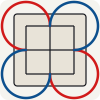
Surakarta board: 6×6 grid with 8 corner loop arcs and starting position
https://engine.moddable.games/play/?game=surakarta&variant=standard
The board is a 6×6 grid of 36 intersection points, connected by horizontal and vertical lines. Pieces are placed on intersections, not inside squares.
At each of the four corners of the board, two concentric three-quarter-circle arcs extend outside the grid boundary:
- Inner loop (blue): connects the 2nd intersection from the corner along each adjacent edge
- Outer loop (red): connects the 3rd intersection from the corner along each adjacent edge
The board has eight loop arcs in total: four inner and four outer, one pair at each corner.
Equipment
| Item | Qty | Notes |
|---|---|---|
| Board | 1 | 6×6 grid of 36 intersections with 8 corner loop arcs |
| Pieces | 24 | 12 per player, in contrasting colours (dark and light) |
Traditional pieces are shells (light) versus pebbles or stones (dark).
Setup
Each player takes 12 pieces of one colour. Place all 12 dark pieces on the 12 intersections of rows 1 and 2 (the two rows closest to the dark player’s side). Place all 12 light pieces on the 12 intersections of rows 5 and 6 (the two rows closest to the light player’s side). Rows 3 and 4 start empty. Players sit on opposite sides of the board, each nearest their own pieces.
Movement
Players alternate turns. On each turn, a player moves exactly one piece.
Non-Capturing Move
Move one piece one step to any adjacent empty intersection. Movement is permitted in all eight directions: horizontally, vertically, and diagonally. A piece cannot move onto an occupied intersection.
Capturing Move
A capturing move must pass through at least one corner loop arc. Captures are optional: a player is never forced to capture even when a capturing move is available.
The path of a capturing move:
- The piece travels along a grid line (horizontally or vertically) away from its starting intersection.
- When it reaches an intersection where a loop arc begins, it follows the arc around the corner.
- After exiting the arc, the piece continues along the perpendicular grid line.
- A single move may pass through more than one loop arc in sequence.
- The piece lands on the first opponent piece it reaches, capturing it by displacement. The captured piece is removed from the board.
- Every intersection along the path, except the destination, must be empty. The capturing piece cannot pass through or jump over any piece.
The four corner intersection points cannot serve as the starting point of a capturing move.
Winning
The player who captures all 12 of the opponent’s pieces wins.
Stalemate: If no further progress can be made, the game ends by mutual agreement. The player with more pieces remaining wins. If both players have equal pieces, the game is a draw.
Attribution
Surakarta. Traditional game attributed to Surakarta (Solo), Central Java, Indonesia. European publication by Ravensberger, Germany, 1971. Public domain. Sources: Ludii Project, Maastricht University (ludii.games, academic game corpus); rubysash/site.hollowedstone implementation reference (MIT licence); Wikipedia, Surakarta (game) (CC-BY-SA 4.0); Masters of Games (mastersofgames.com).